
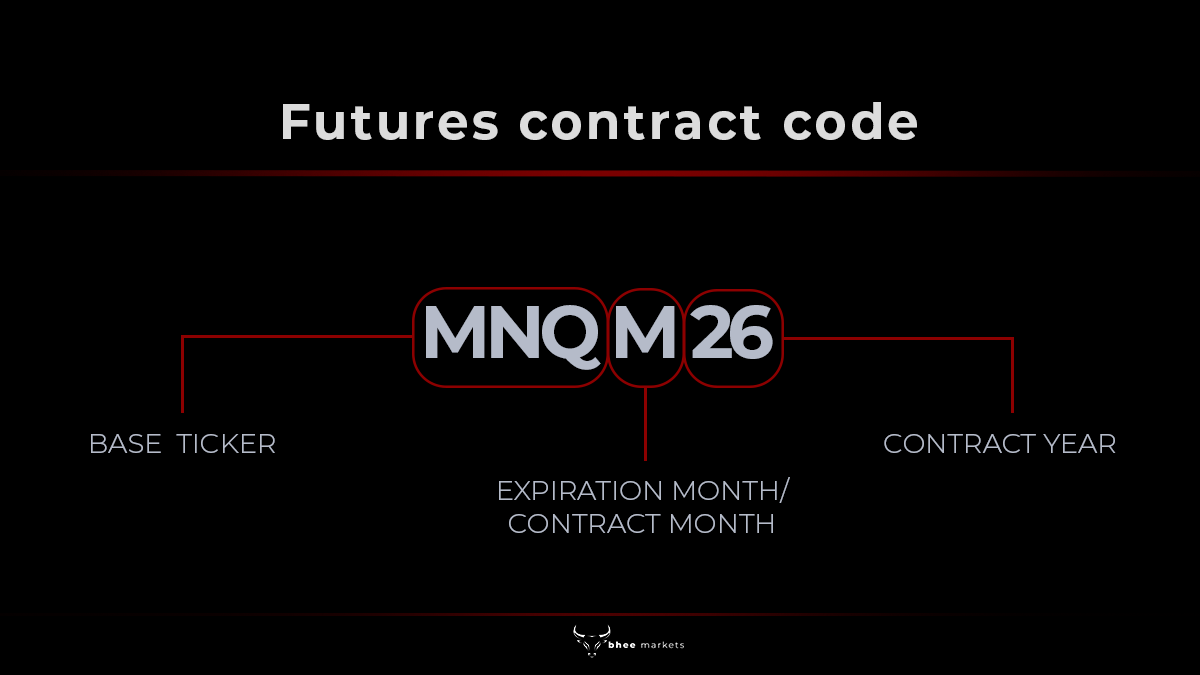
If you just started to trade index futures you might notice that there are different versions of an asset. When you look for MNQ (micro e-mini Nasdaq) for example you‘ll get:
- MNQ1!
- MNQ2!
- MNQH
- MNQM
- MNQU
- MNQZ
So what’s the difference between them and which one should you trade?
Futures contracts expire
Unlike stocks, crypto or CFD‘s – futures contracts expire.
They were originally designed for commodities – farmers and manufacturers locking in prices before the delivery day. That delivery date is the expiration.
Index futures like MNQ don‘t involve physical delivery. But they are designed to lock in a price at a future date. When they expire they’re cash settled and the contract is fulfilled.
Index futures expiration cycle
Index futures expire on a quarterly cycle.
Each letter after the base ticker represents the expiration month.
- H: March
- M: June
- U: September
- Z: December
On some trading platforms like TradingView for example, you can find MNQ1! & MNQ2!.
The 1 in those types of contracts refer to the nearest active expiration and 2 to the following contract in the cycle.
Metal futures expiration cycle
Metal futures do not have a quarterly expiration cycle. They kind of expire on a monthly basis but not every month.
You can check when those contracts expire on barchart.com:
Metals Futures Expirations Calendar – Barchart.com
Energy Futures expiration cycle
Energy futures like crude oil (WTI and Brent) expire on a monthly basis.
Why this matters
Each contract has its own liquidity and volume. At any given time, one contract is dominant, meaning it has the most volume and liquidity. This is called the front month.
Some time before the quarter ends you might notice that execution gets kind of weird, spreads are worse and fills are off.
That usually means that most traders have rolled over from the current quarter contract to the next one. This can happen weeks or days before the contract expires, there is no fixed time for this happening.
So a couple weeks before the quarter ends check which contract has the most volume and trade that one.
You can check this on the CME site:
Micro E-mini Nasdaq-100 Index Futures Quotes – CME Group
or on Barchart.com:
Nasdaq 100 Micro Prices and Nasdaq 100 Micro Futures Prices – Barchart.com
The contract expiration date on the other hand is fixed though. Don’t confuse it with the volume migration.
For MNQ specifically, contracts expire on the third Friday of the expiration month. The rollover in practice happens before that, usually 8 days prior (as a rule of thumb).
Futures contract month codes
- F: January
- G: February
- H: March
- J: April
- K: May
- M: June
- N: July
- Q: August
- U: September
- V: October
- X: November
- Z: December
Knowing which contract to trade is not the only thing that can be confusing for a beginner trader. There is also calculating the right contract size.
This article is for informational purposes only and does not constitute financial advice.