
Entering a trade with a random contract size every time is usually not a good idea. As a trader, risk management can either make or break you. The best approach is to risk 1%-2% on each trade.
But how do you find out what contract size to use for 1% risk?
When i started trading futures, I struggled with that. Everywhere online, all I found was complicated, way too time-consuming formulas. I needed to focus on the actual trade, not on solving a mathematical equation.
Calculating your contract size shouldn’t lead to you missing out on your trade, so in this article, I’ll show you the most simple, quick and easy way to calculate your contract size.
The most simple formula to calculate your contract size in futures trading
The amount you want to risk/SL size/$ value per point=contract size
Futures contract size calculation example
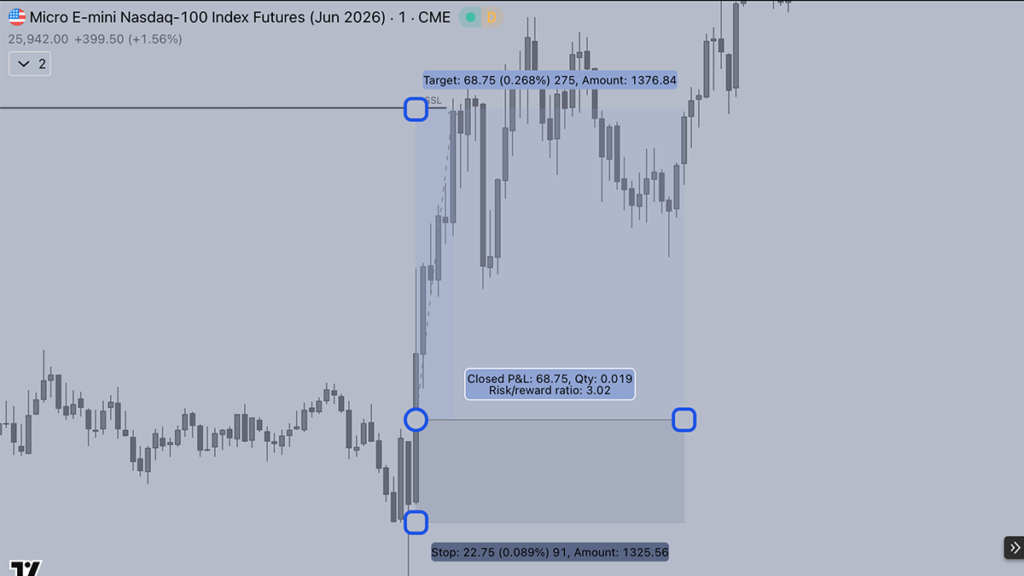
Chart by TradingView
Lets say you are trading MNQ ($2 value per point) and you wanted to risk $1,000 on this trade (stop: 22.75 points), your calculation would have looked as follows:
1,000/22.75/2 = 21.97
Since you can only trade full contracts your risk won’t be exactly $1,000 but as close to it as possible. So you either round it up or down depending on which number is closer to what your calculation got you. In this case you round it up, so your contract size on this trade would have been 22.
$ value per point for different futures instruments
micros:
- MNQ: $2
- MES: $5
- MGC: $10
minis:
- NQ: $20
- ES: $50
- GC: $100
Now that you can easily calculate your contract size, you should choose the right timeframe for you:
This article is for informational purposes only and does not constitute financial advice.