
For decades, nuclear was dead. The Chernobyl disaster in 1986 and the Fukushima Daiichi disaster in 2011 turned public and political opinion against it. Countries shut plants down. Germany phased out it’s entire fleet.
The narrative was clear: nuclear is dangerous, nuclear is over.
But now it’s being forced back into the system.
And the current energy crisis has made the case very clear.
But the crisis isn’t the only catalyst. Another one has been building long before that.
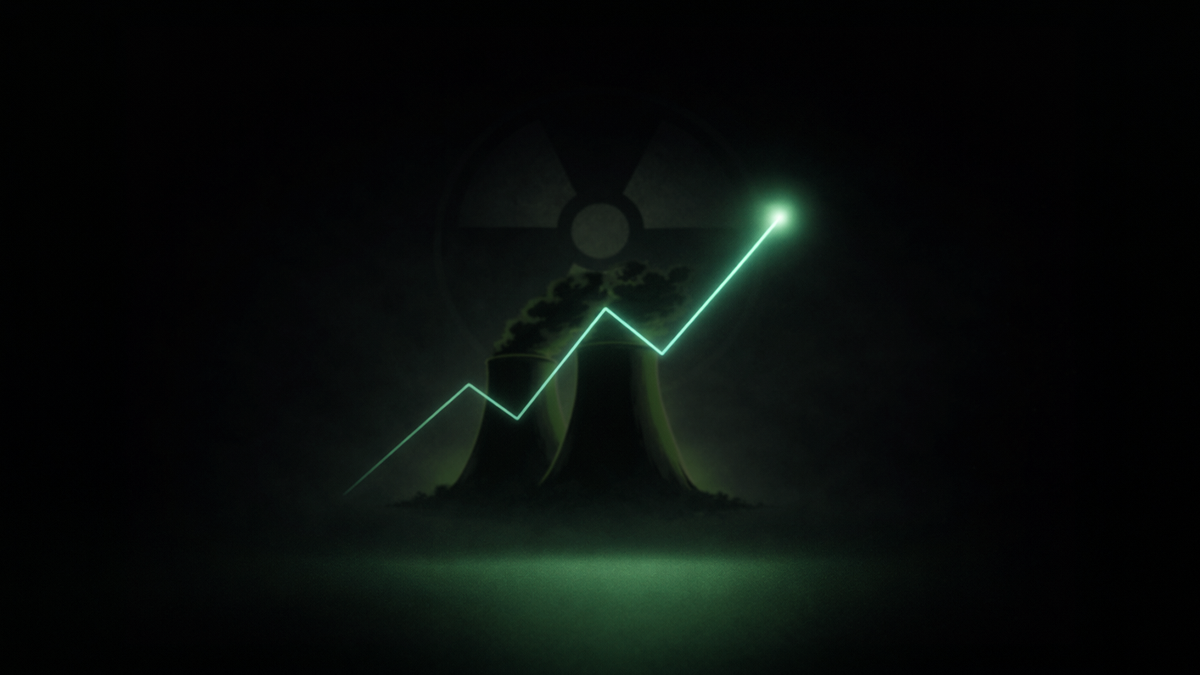
Together, they may have created the market opportunity of the decade: nuclear stocks.
The energy crisis
Right now, the world is experiencing one of the largest energy supply disruptions in modern history.
In late February 2026, the United States and Israel launched strikes on Iran. Iran responded by closing the Strait of Hormuz – a narrow waterway that roughly 20% of the world’s oil and natural gas passes through every single day.
- Oil prices surged
- LNG supplies to Europe were tightened
- Airlines started cancelling flights due to jet fuel shortages
- Some countries introduced emergency conservation and rationing measures
The IEA called it the greatest global energy security challenge in history. And this is with a ceasefire already announced. The Strait still isn’t fully open.
This is the energy crisis. And it didn’t come out of nowhere.
Oil isn’t just what goes in your car.
- It powers factories
- Heats homes
- Moves goods across the world
It is the backbone of the global economy.
When the supply gets disrupted, everything gets more expensive. Fast.
One conflict. One chokepoint. One miscalculation. 20% of the world’s oil supply – gone overnight.
But oil isn’t the only vulnerability.
Europe generates a significant portion of its electricity from gas. That gas travels through pipelines and shipping routes just as exposed to geopolitical disruption as oil. When energy markets shake, the whole system shakes. Electricity included.
Decades of building an energy system on the assumption that geopolitical stability would hold.
It didn’t.
It was never guaranteed.
The vulnerability was always there. The crisis just made it impossible to ignore.
Nuclear sits outside of that equation entirely.
- It doesn’t move through chokepoints
- It doesn’t need a stable shipping lane to keep running
Once a reactor is on, it’s on – producing electricity 24/7, on domestically stored fuel, regardless of what’s happening on the other side of the world.
The AI catalyst
AI isn’t just software. It’s millions of square feet of data centers running at full capacity 24/7, with power requirements that scale with every new model generation.
You simply cannot run that infrastructure on intermittent energy.
The biggest companies in the world are already adapting to this:
- Google partnered with NextEra Energy to restart Iowa’s only nuclear plant – the Duane Arnold Energy Center, to power its AI and cloud operations with 24/7 nuclear energy by 2029. The two companies also signed a separate agreement to explore deploying new nuclear generation across the US.
- Amazon invested $500 million in X-energy and signed agreements to deploy more than 5GW of new nuclear capacity using X-energy’s Xe-100 SMR by 2039, starting with a project in Washington state. Amazon’s investment gives indirect public exposure to this technology through their partnership.
- Meta partnered with Constellation Energy to secure nuclear-backed power
- Microsoft has been exploring nuclear partnerships as well
These are not PR-moves – these are infrastructure decisions made by companies that need guaranteed baseload power.
The policy reversal
This is where it gets structurally significant. Governments are reversing positions they held for decades.
- France is doubling down on nuclear capacity.
- The UK government partnered with Rolls-Royce SMR in 2025 to build factory constructed power plants capable of generating low-carbon electricity for one million homes. The aim here is to strengthen energy security. Rolls-Royce SMR has since entered a partnership with Great British Energy-Nuclear to design and deliver the first SMRs in the UK.
- The United States is supporting advanced reactor development and domestic fuel supply.
- Even Japan has been restarting reactors it previously shut down after Fukushima.
When governments that spent years moving away from something start moving back – and funding it – it hints at the creation of a long term investment cycle.
SMRs: the technology shift
A major reason nuclear is being reconsidered isn’t just necessity – but that the technology has evolved.
Traditional nuclear plants are enormous, expensive and take ten to fifteen years to build. That timeline and cost structure made them increasingly uncompetitive.
Small Modular Reactors (SMRs) aim to change that entirely.
They are smaller reactors built in factories, designed for faster deployment, lower cost and scalable installation.
Instead of one massive nuclear plant, you can deploy multiple smaller units and scale as demand grows. This makes them viable for distributed use cases – powering data centers, industrial sites, remote facilities.
Companies actively working on SMR’s include:
- Rolls-Royce Holdings
- NuScale Power
- Oklo Inc
Most projects are still in development or early deployment phases, but the direction is clear.
Market layers
If nuclear power expands, the capital doesn’t just flow in one place.
There are layers.
- Uranium: the raw fuel. There is no nuclear without uranium. If nuclear demand rises, uranium demand rises as well. And supply is constrained. Cameco is the western world’s largest producer. Kazatomprom is the largest globally.
- Reactor builders: Rolls-Royce Holdings has strong positioning through its SMR program. NuScale Power is a pure SMR bet. Oklo is earlier stage, recently went public via SPAC and is one of the few companies with direct exposure to liquid metal cooling technology.
- Infrastructure and components companies: these make money regardless of which reactor design wins. BWX Technologies builds reactor components, fuel systems and is involved in advanced reactor programs. Fluor Corporation and Jacobs Solutions design and build full nuclear plant infrastructure. Curtiss-Wright supplies pumps, valves and reactor systems.
- Cooling systems: an often overlooked part of the supply chain. A nuclear reactor is essentially a controlled heat source that must never overheat. Cooling isn’t optional – it’s the system. Companies like Flowserve and ITT handle pumps and valve systems for coolant flow. Alfa Laval and SPX Technologies build heat exchangers. Xylem and Veolia handle water infrastructure and purification. These companies benefit from nuclear expansion but also from oil and gas, industrial growth and increasingly data center cooling.
- Utilities: the companies that actually sell the electricity. Constellation Energy and EDF are the key names here.
Finally, there are ETFs for broad exposure. The Global X Uranium ETF provides a basket approach to uranium mining and nuclear infrastructure without single-stock concentration risk.
The advanced technology layer
Beyond conventional water cooled reactors and SMRs, the next generation of nuclear power is being engineered around entirely different cooling systems. This is still frontier territory – not mainstream deployment – but worth understanding because it’s where the technological upside sits.
Traditional nuclear reactors use water as coolant, which limits operating temperature, efficiency and requires massive water access.
Advanced nuclear reactor designs remove water entirely, enabling higher temperatures, greater efficiency and new fuel cycles.
- Sodium and liquid metal cooled nuclear reactors: these use metals like sodium or lead instead of water. They transfer heat extremely well, operate at low pressure and allow much higher temperatures. The tradeoff is engineering complexity – sodium reacts violently with water and air. TerraPower’s natrium project is the most visible advancement here, with its first Wyoming plant already breaking ground. TerraPower is private, but it’s a partnership with GE Vernova, making GE Vernova one of the clearest public market exposures to this technology. BWX Technologies and Curtiss-Wright are also relevant as component suppliers.
- Gas cooled nuclear reactors: these use helium instead of water. Helium is chemically inert, doesn’t become radioactive easily and enables very high operating temperatures – making these reactors suitable not just for electricity but for industrial heat applications. X-Energy is the leading developer with its Xe-100 design, but it’s not publicly traded. BWX Technologies is the most accessible public exposure here, with its own high-temperature gas reactor program underway.
- Molten salt nuclear reactors: these are the most conceptually ambitious. The fuel dissolves in molten salt, which also acts as the coolant – combining both functions in one system. They operate at very high temperatures, at low pressure and can in principle run on nuclear waste. The challenge is materials science – molten salt is highly corrosive and the engineering remains difficult. Most leading developers including Terrestrial Energy and Moltex are not publicly traded.
Of the three advanced cooling paths, sodium and liquid metal has the most visible near-term traction. Gas cooled designs have a compelling long term case for high temperature industrial applications. Molten salt carries the most theoretical upside but also the most commercialization uncertainty.
The structural reality here is important: the most interesting technological developments are mostly happening outside the publicly traded markets.
The risk side
This is not a clean story.
Nuclear always carries political risk. One accident, one policy shift, one change of government can reverse sentiment fast. Cost overruns are endemic to the industry. Construction timelines are historically optimistic. And public/investor perception is of major importance in the markets.
This is also not a short hype cycle. It’s a multi-decade infrastructure buildout.
That means possibly slow starts, policy driven moves and periodic sentiment spikes followed by drawdowns.
Patience is part of the thesis.
The bigger picture
Nuclear power sits at the intersection of three of the most powerful structural forces in the markets right now:
- AI infrastructure demand
- The energy transition
- Geopolitical instability pushing countries towards energy sovereignty
The current crisis has made that clearer than ever.
Energy that depends on stability that was never guaranteed is not energy security.
Nuclear is one of the few answers that doesn’t have that problem.
This article is for informational purposes only and does not constitute financial advice.